Performance Evaluation
While building Emerald we have put an emphasis on performance testing with the goal of understanding its limits. While tuning the execution client and the Malachite consensus engine is very application dependant, the goal is to get a best-case baseline to understand any potential overhead introduced by applications built on top of Emerald.
Malachite
Emerald is built on top of Malachite, a high performant version of the Tendermint consensus algorithm.
To understand the overhead of running with an execution client, we first benchmark Malachite without Reth.
We run a simple channel-based application on top of Malachite. The application only generates blocks of a certain size,
and forwards them to peers for voting.
As Malachite does not support variable block sizes in its channel based example app, we added this functionality to our own fork.
Setup
- Block size: 1KiB, 1MiB, 2MiB
- Deployments: single datacenter and geo-distributed
- Number of nodes: 4, 8, 10
- Hardware setup: Digital Ocean nodes, 8GB RAM, 4CPUs, with regular SSDs
Results
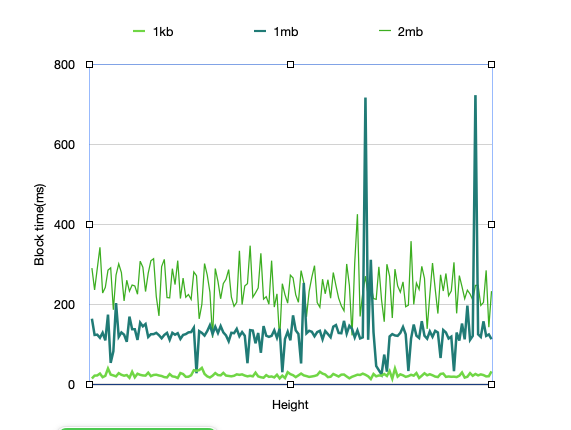
Single datacenter deployment on 4 nodes, with a varying block size. The average block time for 1MiB blocks is 133 ms.
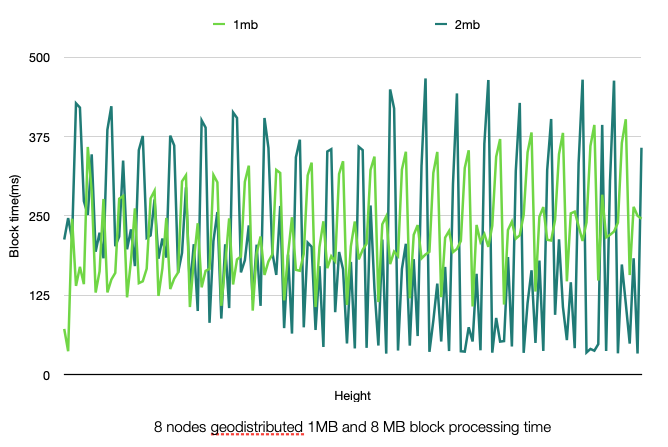
Geo-distributed deployment on 8 nodes, with each 2 nodes in a different datacenter (NYC, LON, AMS, SFO). The geo-distribution impacts performance, with spikes in block times. The time for 1MiB blocks varies around 230ms, but has spikes above 300ms.
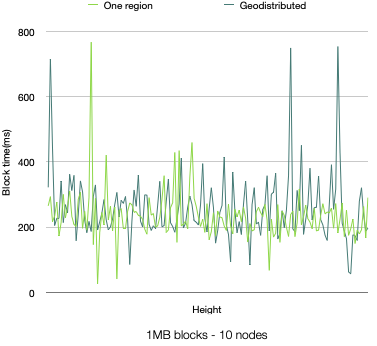
Deployment on 10 nodes, both in a single datacenter and geo-distributed, with 1MiB blocks. No significant difference from running on 8 nodes.
Although the channel-based application deployed on Malachite doesn’t have a concept of transactions, we can consider “native” Ethereum EOA-to-EOA transfers (i.e., plain ETH sends), which have ~110bytes. In this context,
- a single datacenter deployment on 4 nodes with 1MiB blocks and average block time of 133ms results in around 71.7k TPS
- a geo-distributed deployment on 8 nodes with 1MiB blocks and average block time of 230ms results in around 41.4k TPS.
Emerald
Configuration
For optimal performance, it is important to tune the execution engine according to application requirements.
The goal here is to push the system to achieve high throughput, while keeping it stable. By stable we mean handling incoming transactions without filling up the mempool, building blocks fast enough to keep up with consensus and sending data within the network to avoid congestion at the RPC level.
We use the following changes to the default Reth node configuration:
    "--txpool.pending-max-count=50000",
    "--txpool.pending-max-size=500",
    "--txpool.queued-max-count=50000",
    "--txpool.queued-max-size=500",
    "--txpool.basefee-max-count=50000",
    "--txpool.basefee-max-size=500",
    "--txpool.max-account-slots=100000",
    "--txpool.max-batch-size=10000",
    "--txpool.minimal-protocol-fee=0",
    "--txpool.minimum-priority-fee=0",
    "--txpool.max-pending-txns=20000",
    "--txpool.max-new-txns=20000",
    "--txpool.max-new-pending-txs-notifications=20000",
    "--max-tx-reqs=10000",
    "--max-tx-reqs-peer=255",
    "--max-pending-imports=10000",
In addition we are setting the --builder.gaslimit to 1_000_000_000 for cloud-based deployments and to 200_000_000 for bare-metal deployments.
For your particular setup this might be suboptimal.
These flags allow a very high influx of transactions from one source.
They are buffering up to 50_000 transactions in the mempool, and gossip them in big batches.
We also increased the buffer for pending tx notifications to 20_000 (from the default of 200).
As transactions, we use “native” Ethereum EOA-to-EOA transfers (i.e., plain ETH sends). A set of spamming nodes are injecting transactions signed by different accounts. Every spammer is sending transactions to one single Reth node.
Cloud-Based Deployment
Setup
- Deployments: single datacenter on 4 nodes and geo-distributed on 8 nodes
- Hardware setup: Digital Ocean nodes, 64GB RAM, 16CPUs, with regular SSDs
Results
Single datacenter deployment, 4 nodes. For a single datacenter deployments on 4 nodes, with block sizes of 0.5MiB to 1MiB, we observed a throughput of around 8000 TPS sustained. The reported block time is averaging at 220ms with spikes up to 230ms.
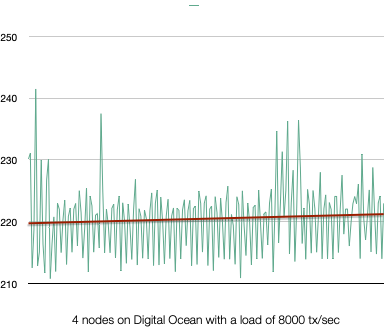
Single datacenter deployment on 4 nodes. Average block time of 230ms.
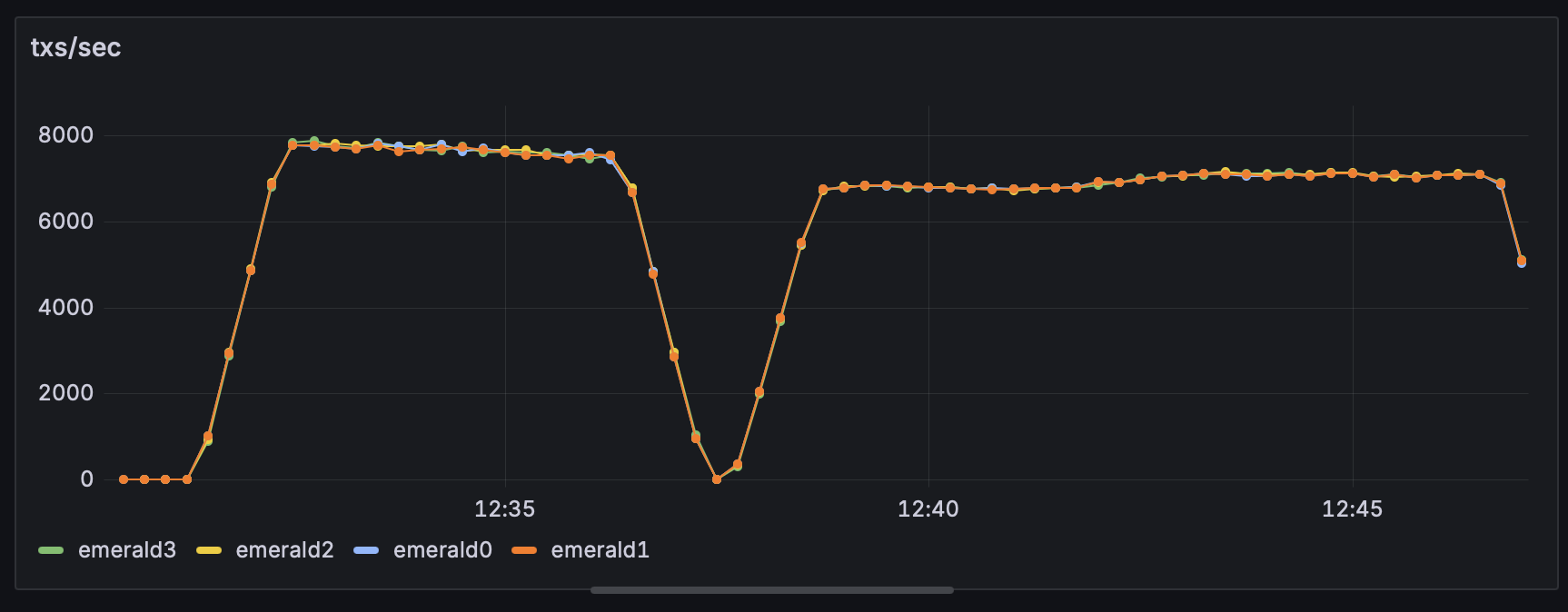
Single datacenter deployment on 4 nodes. 8000 TPS sustained.
Note that when injecting a higher number of transactions into a node, we observed instabilities most likely on the RPC side. Thus, we split the injection into multiple RPC requests. Sending batches every 200ms leads to 8000 TPS sustained. Sending more frequently, every 100ms, results in a drop of performance.
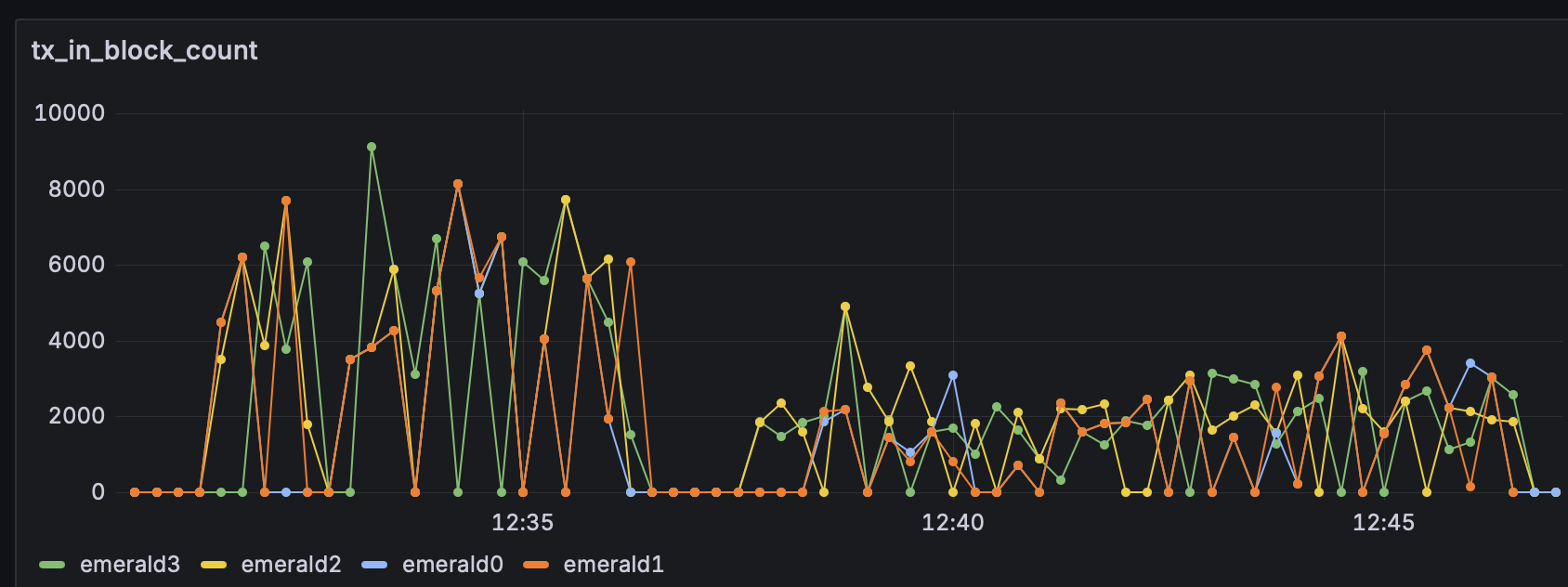
Single datacenter deployment on 4 nodes. Number of transactions per block.
Geo-distributed deployment, 8 nodes. For a geo-distributed deployment on 8 nodes, with two nodes placed in each datacenters (NYC, LON, AMS, SFO), we observed a throughput of around 5800 TPS sustained. The reported block time is averaging at 220ms.
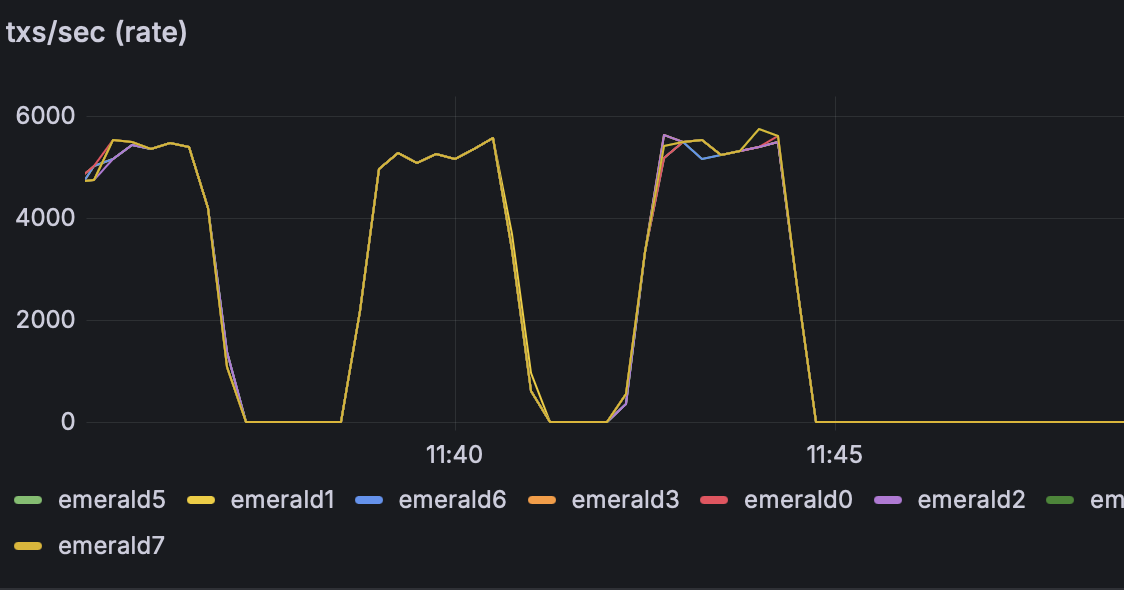
Geo-distributed deployment on 8 nodes. 5800 TPS.
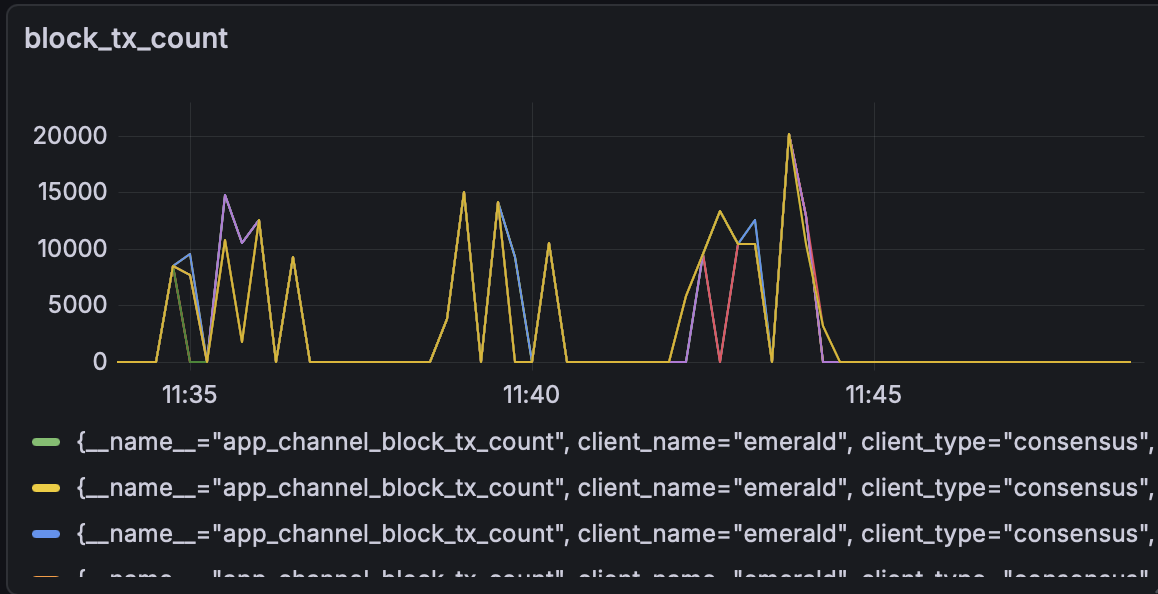
Geo-distributed deployment on 8 nodes. Number of transactions per block.
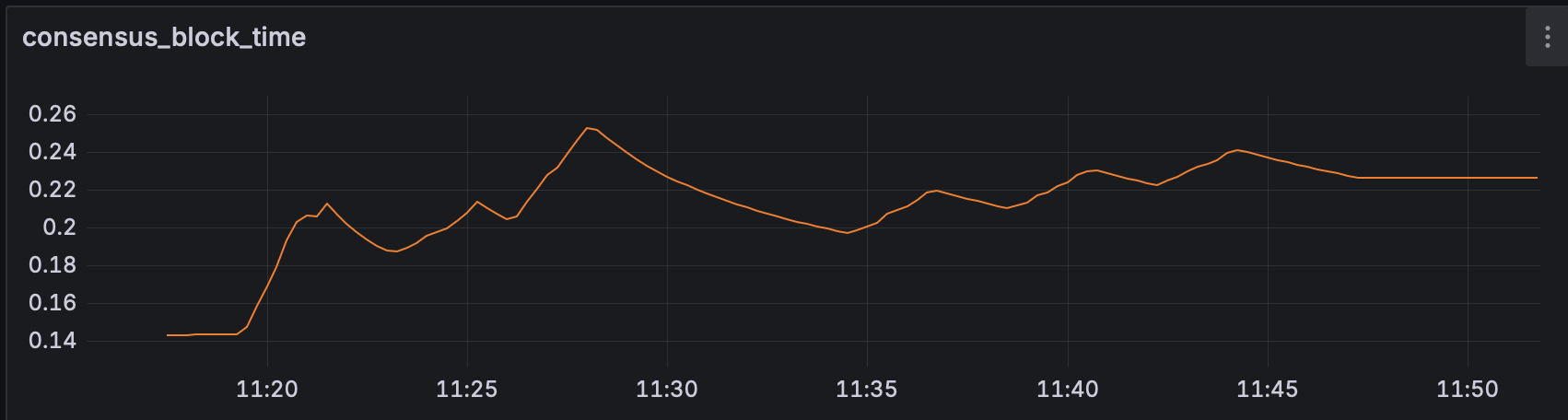
Geo-distributed deployment on 8 nodes. Average block time of 220ms.
Bare-Metal Deployment
Setup
- Deployments: single datacenter on 4 bare-metal nodes
- Hardware setup: 32Gb RAM, AMD EPYC 4584PX CPU, Micron 7500 1TB NVMe
These experiments evaluate Emerald on 4 bare-metal machines in a local and geo-distributed setup. The goal is to understand the absolute best performance the chain can have.
Results
We observed a throughput of around 9200 TPS peak and 8300 TPS sustained. The reported block time was between 170ms to 230ms.
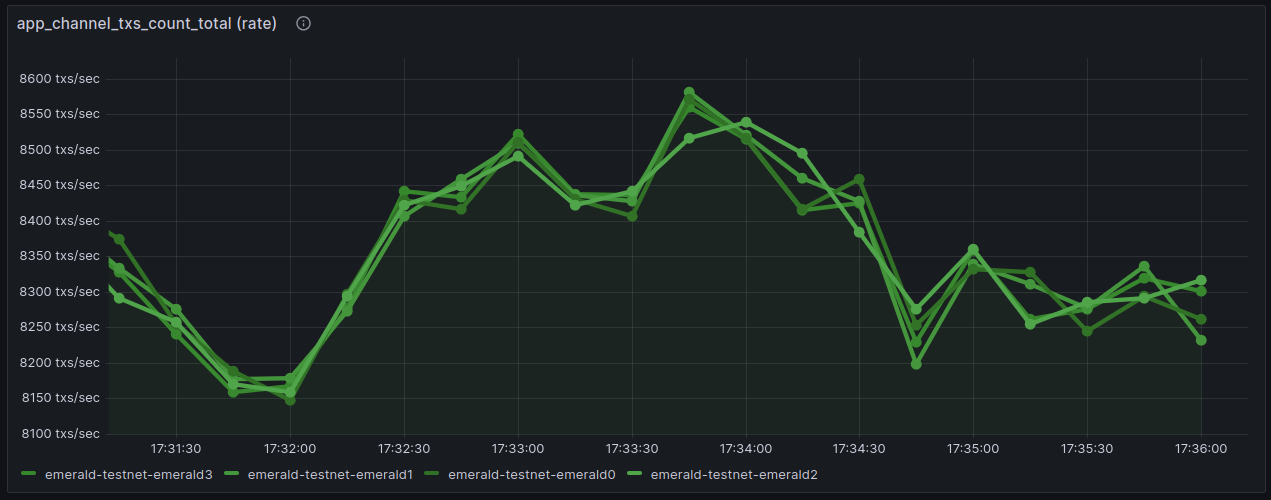
Bare-metal deployment in a single datacenter deployment on 4 nodes. **8300 TPS** sustained.
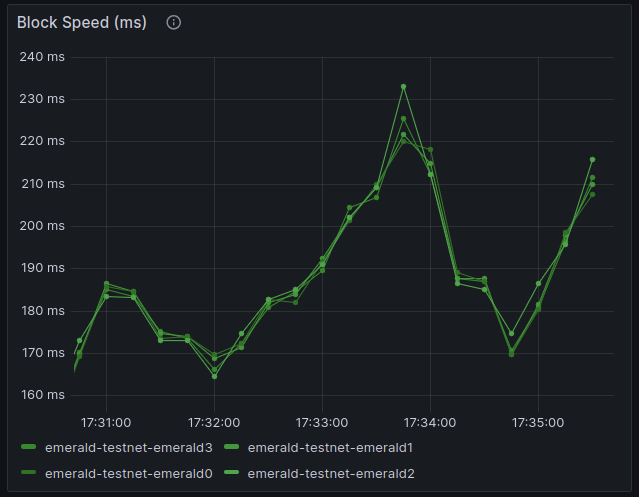
Bare-metal deployment in a single datacenter deployment on 4 nodes. Block time between 170ms and 230ms.
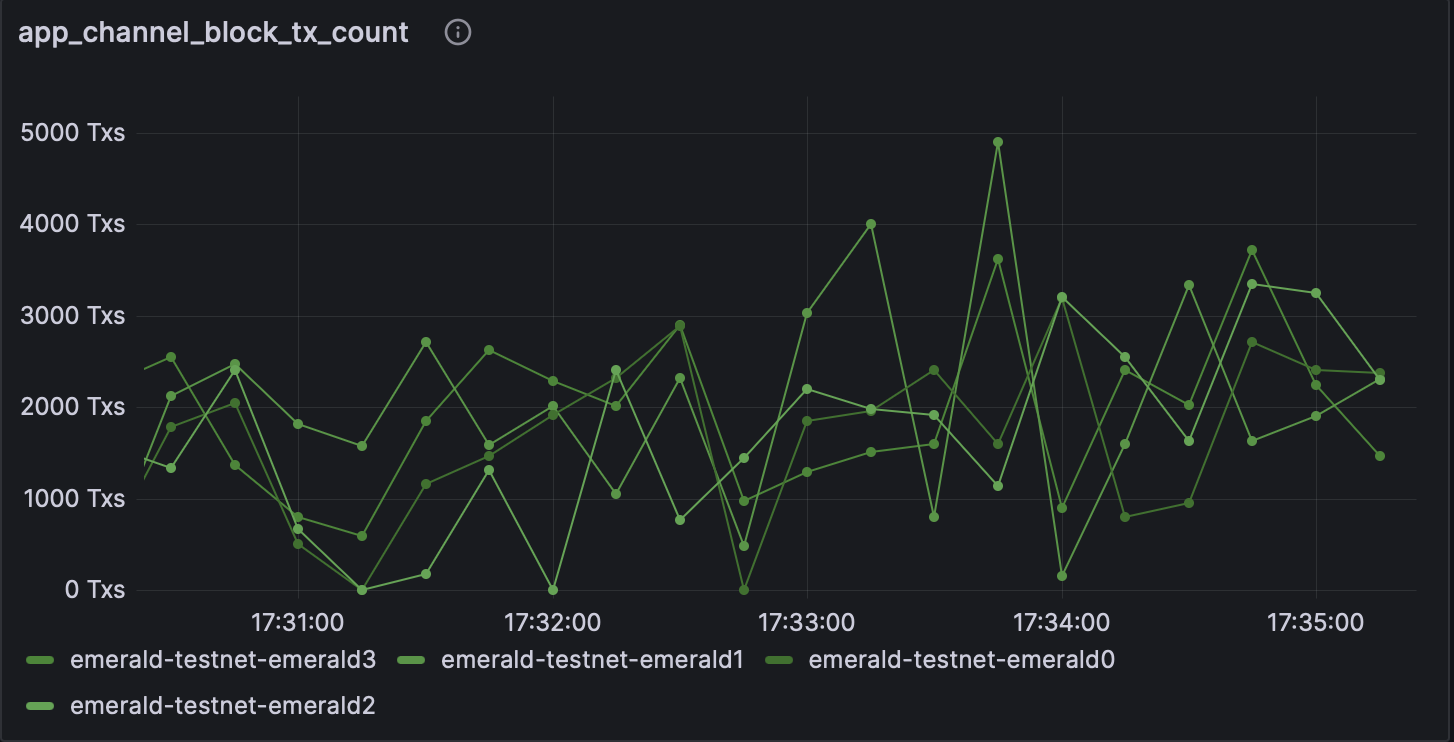
Bare-metal deployment in a single datacenter deployment on 4 nodes. Number of transactions per block.